Following the Ridgeline of Hanzan
Posted on June 16, 2025
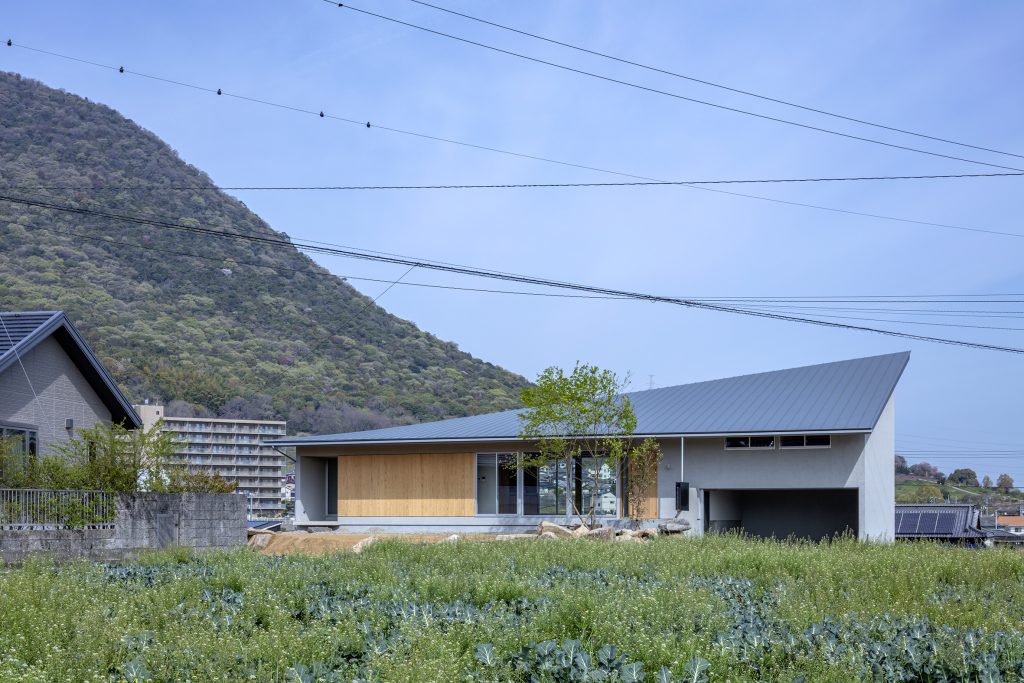
Following the Ridgeline of Hanzan
When I begin to think about architecture, my thoughts always return to the question of how it should be.
Not how to build, but how to exist there.
Before a building becomes “architecture,” it is first a single presence within a landscape—what it learns from, what it follows, and what it quietly lets go of. These questions form the starting point of design.
In Hanzan, Kagawa Prefecture, where the foothills stretch gently outward, we placed a small house.
Rather than making it stand out, we chose to let it step back, to recede.
This was not an attempt for architecture to imitate nature, but to allow it to become part of the scenery itself.
The roof draws a soft arc, quietly echoing the ridgeline of the mountains.
The deep eaves receive the rain, filter the sunlight, and gently convey the passing of the seasons.
Beneath them, people naturally pause, able to linger in the threshold between inside and out.
I believe architecture can be not something that divides, but something that connects.
Inside, the house is composed as a skip-floor.
Through subtle differences in level, lines of sight intersect and air flows slowly.
The steps are not mere functions; they bring a delicate rhythm to the space, softly guiding human movement and relationships.
A reading corner, the kitchen, a place to play—each remains loosely separated yet gently connected.
There exists a tender relationship here that could never be found in a uniform plan.
I do not like architecture that imposes itself upon its inhabitants.
What matters is the kind of space in which residents, through small gestures and quiet moments, can gradually build a relationship with their home.
This house, too, holds many small margins of possibility:
a dirt-floor space where rooms meet,
a ledge to sit upon at a change in level,
a single window reflecting the seasons.
Such places slow the tempo of daily life and lend it depth.
A house does not begin when it is completed.
It becomes a true home only as memories accumulate,
as sounds, light, and textures seep gently into its fabric,
until at last it grows into “a house suited to its land.”
The landscape seems unchanging, yet it is always in quiet motion.
Entrusting itself to that movement, the house will also transform little by little.
And if, five or ten years from now, someone were to see this place and feel
“as though it had always been here,”
perhaps that would be the truest answer of all.
Located in Marugame, Kagawa
Completion : Apr. 2025
Use : Exclusive Occupation House
Structure : Wooden / 2 stories
Site Area : 544.44 sq m
Building Area : 124.74 sq m
Total Floor Area : 146.97 sq m
Photo : Kazunori Nomura